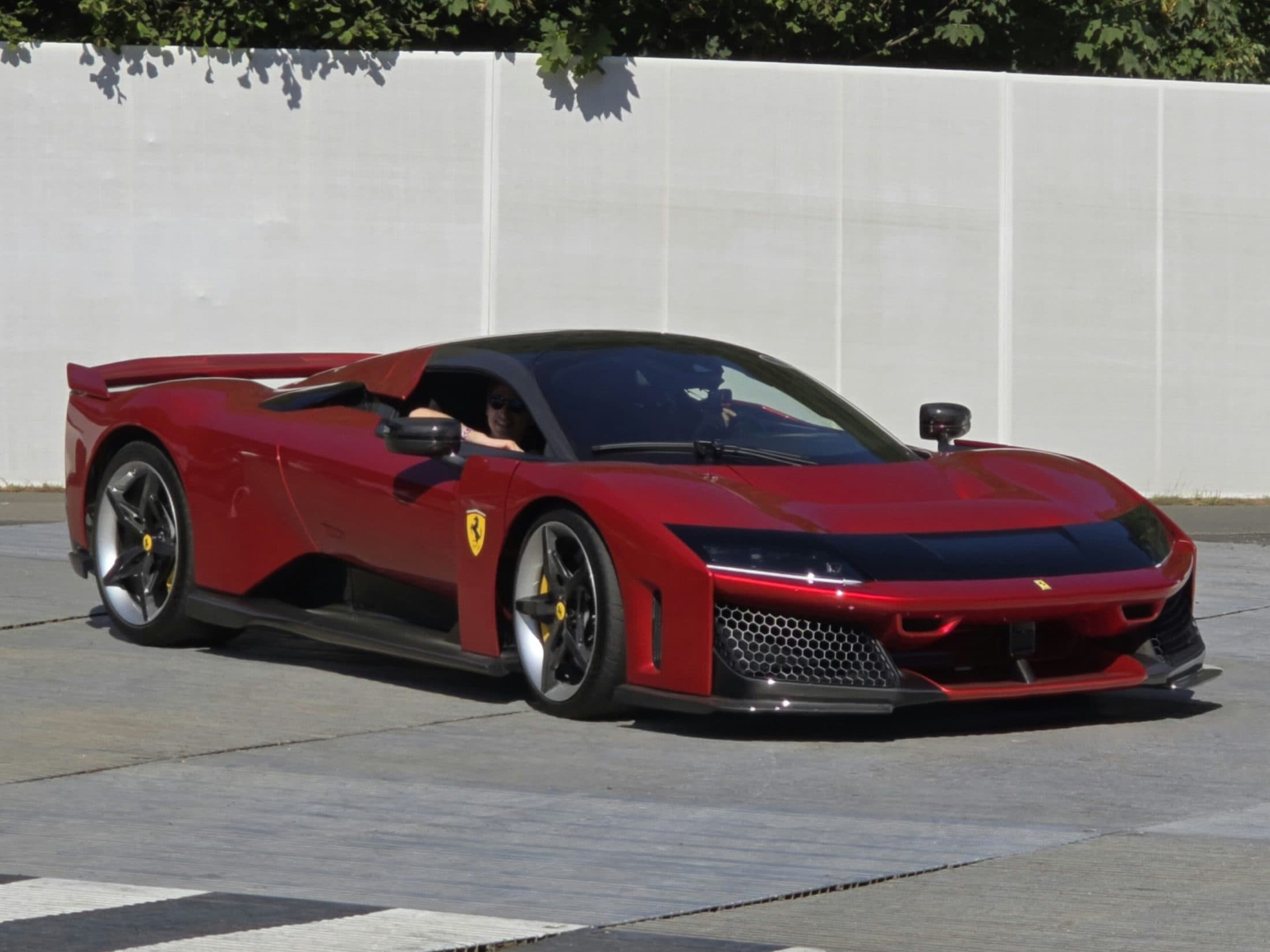
1,200 cv from a hybrid V6, active aerodynamics and just 799 examples. A closer look at the car that succeeds LaFerrari.
Ferrari builds a hypercar roughly once a decade, and each one becomes a reference point for its era. The F80 follows the 288 GTO, F40, F50, Enzo and LaFerrari — and it is the most technically ambitious of them all.
A V6 with Le Mans DNA
Instead of a V12, the F80 uses a 3.0-litre twin-turbocharged V6 derived from the 499P that won at Le Mans. Combined with three electric motors — two on the front axle and one at the rear — total output reaches 1,200 cv, making it the most powerful road-going Ferrari ever built.
- Powertrain
- 3.0 V6 twin-turbo + 3 e-motors
- Total output
- 1,200 cv
- 0–100 km/h
- 2.15 s
- 0–200 km/h
- 5.75 s
- Top speed
- 350 km/h
- Production
- 799 cars
Aerodynamics first
The body is shaped around an S-Duct at the front and an active rear wing, together generating up to 1,050 kg of downforce at 250 km/h. Active suspension keeps the platform stable, allowing the car to run a ride height that would be impossible with conventional dampers.
For wheel designers, the F80 is a lesson in integration: brake cooling, airflow and unsprung weight are treated as part of the aerodynamic package rather than an afterthought.
Photo: Calreyn88 / Wikimedia Commons, CC BY-SA 4.0